

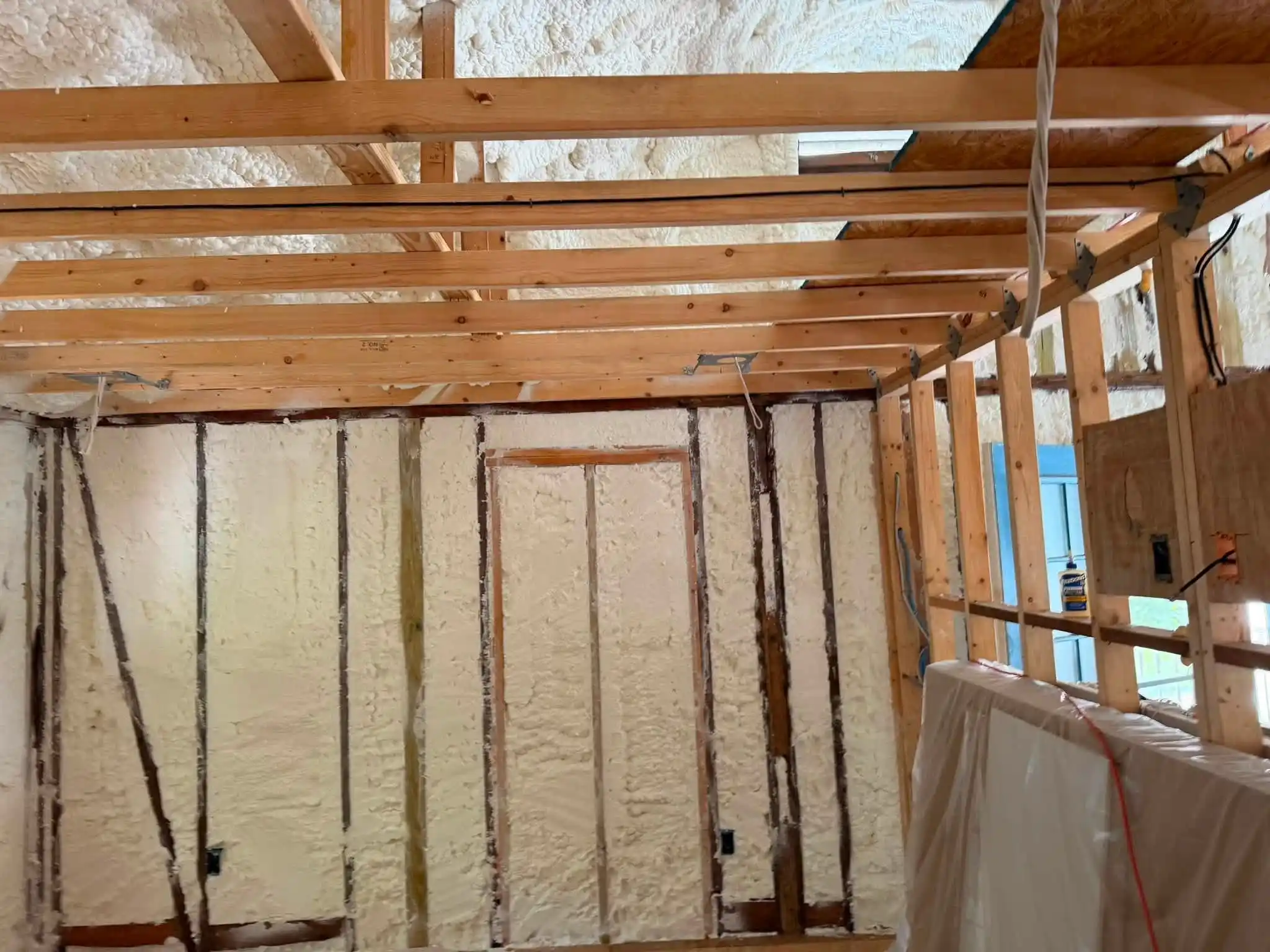
Residential spray foam insulation is a two-part foam sprayed into attics, walls, crawl spaces, and rim joists, where it expands to insulate and air-seal in a single step. It comes in open-cell and closed-cell types, is installed by trained crews in one to two days on most homes, and can cut heating and cooling waste when the job is done right.
Spray polyurethane foam starts as two liquid chemicals stored in separate heated drums. Hoses carry both to the spray gun, where they mix and react. The liquid expands within seconds, often many times its starting volume, then cures into solid foam that grips wood, concrete, and metal.
That expansion is the point. Wall cavities, rim joists, and rooflines are full of gaps that batts slide past. Foam fills the gaps and hardens in place, so the insulation and the air seal become one continuous layer. The Building Science Corporation residential spray foam guide explains that foam can handle water, air, vapor, and heat control in a single material, which is a job no batt or loose fill manages on its own.
Comfort problems usually have a simple cause: conditioned air slipping out through gaps the insulation never covered. Foam attacks that loss directly, and the results show up in a few predictable places.
Most residential spray foam insulation benefits trace back to that air seal. Once the leaks stop, your heating and cooling system cycles less often, and the house holds its temperature for hours longer between runs.
The two types share a name but behave differently, and the choice affects cost, moisture handling, and where each one belongs in the house.
| Feature | Open Cell | Closed Cell |
|---|---|---|
| R-value per inch | About 3.6 | About 6.5 |
| Density | Soft, roughly 0.5 lb per cubic foot | Rigid, roughly 2 lb per cubic foot |
| Moisture | Lets vapor pass through | Resists water; vapor retarder at 1.5 inches |
| Sound absorption | Excellent | Good |
| Installed cost, DOE averages | $1.70 to $2.50 per sq ft at 3.5 inches | $1.30 to $2.00 per sq ft at 1 inch |
| Common uses | Interior walls, attics in mild climates | Crawl spaces, rim joists, basements, roof decks |
Building science adds a few hard rules to the decision. Both types work in wall cavities in most climates, but the rules tighten in specific spots. Unvented attics in colder climate zones call for closed cell on the roof deck, vented crawl spaces call for closed cell only, and open cell should never sit under a basement slab. Matching the foam to the location is what prevents moisture problems years down the road.
Spray foam is not an every-surface product. These are the areas where it earns its cost, and each one has a reason.
A professional home spray foam insulation installation follows the same sequence on nearly every job, and the details inside each step decide how the foam performs for the next few decades. Knowing the rhythm also tells you how to prepare your family and your schedule.
Most single-area jobs wrap in a day. Whole houses with two foam types or heavy prep can run longer, and your crew should give you an honest window before work starts.
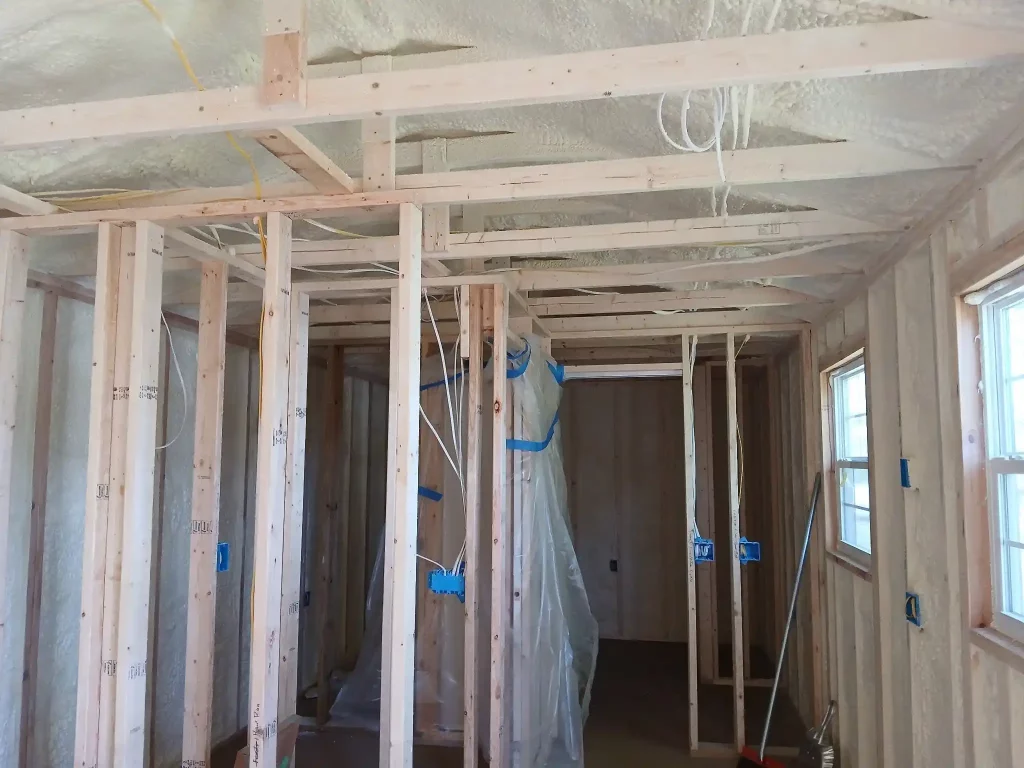
There is no single number, because prices swing with foam type, thickness, square footage, access, and how much prep the space needs. A crawl space full of wet old insulation costs more per square foot than a clear attic deck.
The Department of Energy publishes general installed averages: roughly $1.70 to $2.50 per square foot for open cell at 3.5 inches and $1.30 to $2.00 for closed cell at 1 inch. Treat those as planning numbers, not quotes.
Two things matter more than the sticker price. First is the R-value the job actually delivers, measured against the thickness on the proposal. Second is air sealing quality, because a cheap install that misses gaps leaves you paying for foam you never feel. Get quotes that list board footage, foam type, and target thickness so you can compare like for like.
Foam failures almost always trace back to process shortcuts, not the chemistry itself. Watch for these five.
If your rooms fight over one thermostat setting, or the upstairs never cools down, air leakage is usually the reason. We insulate attics, walls, rim joists, and crawl spaces, and our residential spray foam insulation services always start with a free quote so you know the scope and the number before any work begins. Call Spray Foam Contractors LLC at (239) 688-4979 or email [email protected].
Yes. Attics, rim joists, crawl spaces, and basement walls can be sprayed without disturbing finished rooms. Enclosed wall cavities usually need small access holes or retrofit injection foam, so most homeowners plan wall work around a renovation.
The EPA considers properly applied and fully cured foam relatively inert. The exposure risk sits in the spraying and curing window, which is why residents stay out until the manufacturer’s re-entry time passes.
Cured foam adheres to the surface and never sags or settles, so a correctly installed job keeps performing for decades. Installation quality and moisture conditions matter more than age.
Cans and small kits handle single gaps and rim joist touch-ups. Whole attics need two-component rigs with controlled chemical ratios, substrate temperature, and thickness checks, which is professional territory.
Sealing the gaps pests use to enter definitely helps, and cured foam gives them no food value. It is not a true pest barrier, though, because some rodents and insects can still chew or tunnel through it.