

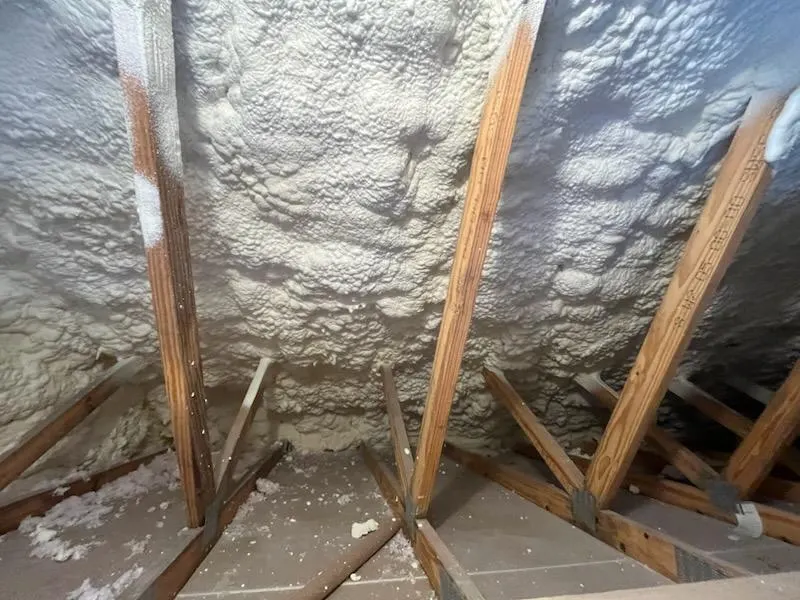
Spray foam insulation works through a two-liquid chemical reaction: an isocyanate (Side A) and a polyol resin (Side B) meet at the tip of a heated spray gun, react on contact, and expand up to 30 to 60 times their liquid volume before curing into solid polyurethane foam. That expansion lets the material fill every crack, gap, and irregular cavity in a wall or attic, which is exactly what homes in Lehigh Acres, FL need. Our long, humid cooling season punishes leaky building envelopes, and most energy waste here happens when hot, moisture-loaded air pushes into attics and wall cavities. The right choice depends on the spray foam insulation application: open cell spray foam fits attic retrofits and sound control, while closed cell spray foam delivers higher R-value and moisture resistance for walls, crawlspaces, and rooflines.
Spray polyurethane foam is not a rolled or blown product, it is made on site. Side A contains isocyanates, a highly reactive chemical family, and Side B contains a polyol resin blended with catalysts, flame retardants, blowing agents, and surfactants. When the two streams mix at the gun tip, they react within seconds, foam outward, and cure into a lightweight solid. Polyurethane itself dates to 1937, and rigid foam has been used as building insulation in the United States since 1979, so the chemistry is well proven.
Most insulation only slows conductive heat flow. Spray foam insulation attacks every heat transfer mode at once:
Air sealing is the reason foam consistently outperforms batts of comparable R-value in real-world conditions, since air infiltration bypasses fibrous insulation but cannot bypass a bonded foam layer.
Lehigh Acres is one of the fastest growing communities in Lee County, home to 114,287 residents as of the 2020 Census, and a large share of its housing stock went up quickly during the 2003 to 2007 building boom Wikipedia – Lehigh Acres, Florida. Fast-growth subdivisions plus Southwest Florida heat create a specific problem profile:
ENERGY STAR‘s climate zone data puts our region in the warmest modeling categories, where air sealing plus attic insulation still cuts heating and cooling costs by 5% to 9%, and the national average reaches 15% on heating and cooling. Foam also improves humidity control and reduces pollen, dust, and pest entry, benefits ENERGY STAR specifically credits to a sealed envelope.
Homeowners ask us about this choice more than any other topic, and the answer depends on where the foam goes.
| Attribute | Open Cell Spray Foam | Closed Cell Spray Foam |
|---|---|---|
| Density | Half-pound, soft and sponge-like | Two-pound, rigid to the touch |
| R-value per inch | About R-3.6 to R-3.8 | About R-5.5 to R-6.5 |
| Air barrier | Yes, at 5.5 inches or more | Yes, at minimum installed thickness |
| Vapor barrier | No, breathable cell structure | Yes, when installed at required thickness |
| Expansion | High, fills voids and cavities | Moderate, builds thickness in passes |
| Best uses in Lehigh Acres | Attic rooflines, interior walls, sound control | Walls, crawlspaces, roof decks, moisture-exposed areas |
| Sound dampening | Strong absorber of airborne noise | Moderate |
Open-cell foam insulation suits our vented attic retrofits where coverage volume matters and moisture is managed with ventilation and AC. Closed-cell earns its cost where water, humidity, or thin cavities demand a rigid, sealed assembly.
Pricing depends on square footage, target R-value, and access. Our current project ranges look like this:
| Service | Typical Low | Typical Average | Typical High |
|---|---|---|---|
| Open cell spray foam | $4,000 | $9,000 | $30,000 |
| Closed cell spray foam | $4,000 | $30,000 | $100,000 |
| Attic insulation | $4,000 | $6,500 | $30,000 |
| Insulation removal | $4,000 | $6,500 | $30,000 |
| Insulation replacement | $4,000 | $6,500 | $30,000 |
Pricing moves up with larger square footage, greater thickness or higher R-value targets, difficult access, old insulation removal, steep roof pitch, material price changes, and travel distance. Easy, open-access jobs price lower. We take jobs of any size when a customer accepts our minimum trip fee for crew and equipment, though projects under 1,000 square feet are generally the ones we try to avoid.
| Property Type | Recommended Foam | Why It Works |
|---|---|---|
| Retrofit homes (1,500 to 2,500 sq ft) | Open cell attic insulation | Fast air sealing of the roofline where most heat enters |
| Larger homes (2,500 to 4,000 sq ft) | Open cell attic plus closed cell walls | Balanced R-value and humidity control across the envelope |
| New construction | Closed cell walls, open cell attic | Code-ready performance built in before drywall |
| Crawlspaces | Closed cell | Vapor barrier plus insulation in one product |
| Commercial buildings | Closed cell | Rigid, high R-value coverage for metal and masonry assemblies |
Spray Foam Contractors LLC installs open-cell and closed-cell spray foam in Lehigh Acres, FL, and surrounding Lee County, with full attic insulation, insulation removal, and insulation replacement services. Call us at (239) 688-4979 or email [email protected] and our team will evaluate your home, explain the right foam for each area, and give you a clear, itemized plan.
Request a Free Quote | Schedule a Home Insulation Assessment
Stop paying to cool the outdoors, let our crew seal your home the right way.
Most attic projects are completed in one to two days depending on square footage and preparation. Foam cures within hours, and we confirm safe reentry timing before you return to the space.
There is a low-odor period during application while occupants stay out of the work area. Once cured, the foam is inert and stable, and proper installation practice removes lingering odor concerns.
Open cell is the usual choice for vented attics because it fills the roofline efficiently and adds sound dampening. Closed cell is better where moisture exposure, thin cavities, or maximum R-value per inch is the priority.
In most retrofit attics, yes, removal ensures the foam bonds directly to clean sheathing and lets us spot air leaks. Our insulation removal and replacement services average $6,500 per project.
ENERGY STAR modeling shows air sealing plus attic insulation saves 5% to 9% on heating and cooling in the South’s warmest zones, with higher savings for homes that start under-insulated. Your actual result depends on the home’s current condition and AC usage.